
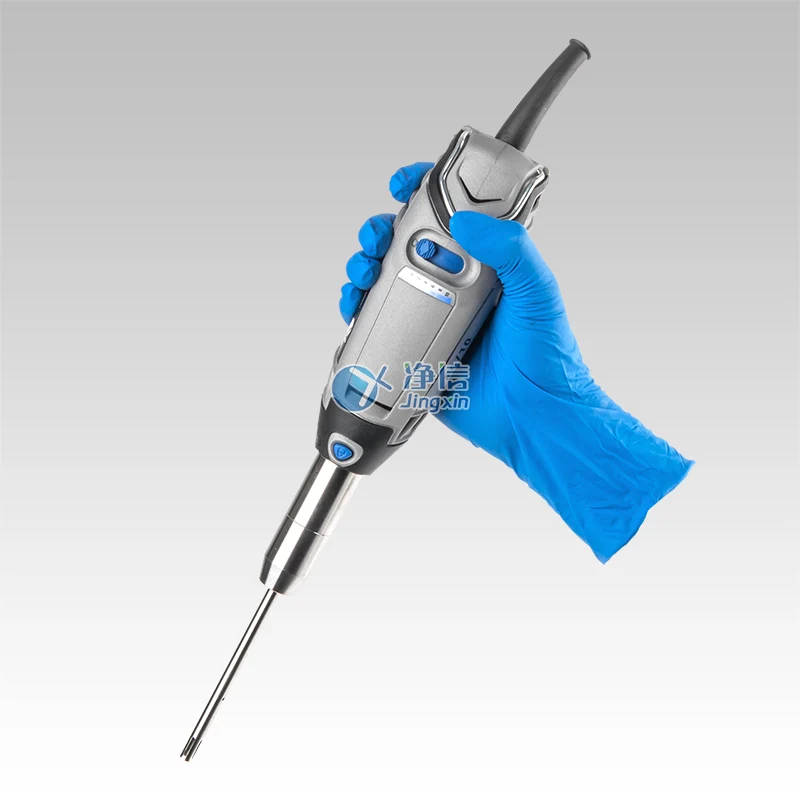
Product category · Technique / method route

Handheld & Hand-Held Tissue Homogenizers

Choose a handheld tissue homogenizer when the job is one sample at a time, the volume is small, or the preparation happens away from a bench-mounted instrument. Confirm probe or tip compatibility, cleaning and containment before assuming the route scales.

Also described as: handheld tissue grinder · hand held tissue grinder · motor driven tissue grinder · battery tissue grinder · electric or electronic tissue grinder · mechanical tissue grinder · plastic tissue grinder · tool to grind up tissue · tissue homogenizer tips.

F6/10 product
Representative model: F6/10
PRODUCT FAMILYHandheld / probe homogenizationCompare model specifications below.
FamilyHandheld & probe
WorkloadSingle sample / small volume
PowerMains, battery or motor-driven by configuration
Main decisionVolume + probe or tip + containment
Product models

Compare handheld homogenizers

Working volume, speed and dispersing-head options come from the product information.

ModelWorking volumeSpeedStandard toolWeight
F6/10Handheld Tissue Homogenizer0.2–250 mL5000–35000 rpm10G dispersing head1 kgView model →
Choose this route when

Handheld homogenizer sample fit

A handheld or probe homogenizer is a technique route, not a throughput route. It is the practical choice when the workload does not justify a batch instrument and when one sample must be processed immediately.

  • One sample or a few samples at a time.
  • Small working volume in a tube, vial or micro-tube.
  • Preparation happens away from a fixed instrument.
  • Probe, tip or dispersing tool is part of the method.
Choose another route when

When to choose another route

Move to bead-mill or high-throughput routes when many samples must be processed under identical conditions, and to manual glass routes when a classic loose/tight pestle method is required.

View all homogenizer routes →
Selection logic

Handheld selection checks

These checks become structured product fields, so sales does not need to ask the same questions again.

01Sample & volume

Material, mass or volume per sample and working volume of the vessel.

02Probe or tip

Dispersing tool diameter, shaft length and compatible vessel.

03Containment

Aerosol, cross-contamination and cleaning between samples.

04Power & location

Mains, battery or motor-driven use, and whether the work happens off-bench.

05Downstream goal

Lysate, cell suspension, powder or mixing, and the analysis that follows.

Selection matrixUse model-specific values only
Sample fitDefined by approved sample application and evidence records, not by category name.
Volume rangeWorking volume per sample and the vessel the probe or tip enters.
ToolProbe, dispersing tip or generator geometry, plus spare seals and wear parts.
CleaningBetween-sample cleaning, decontamination boundaries and validated methods.
PowerMains, battery or motor-driven configuration, voltage and market.
BudgetUnit + probes or tips + spare wear parts + cleaning consumables.
Route comparison

Compare homogenization methods

Compare the method first. Two routes can reach a similar result while differing completely in reproducibility, containment and cost structure.

Method routesDecide by method, then by model
Handheld / probeOne sample at a time, direct contact with the sample, tool cleaning between samples. Practical for small volumes and off-bench work.
Bead-mill grindingBatch processing in sealed tubes or plates with grinding beads. Better suited to repeatable batches and closed-vessel handling.
Manual glass (Dounce / pestle)Loose and tight pestle clearance with manual strokes. Classic low-volume cell work where the operator controls the stroke.
Disposable / sterileSingle-use format where cross-contamination control matters more than per-sample cost.
Tips, probes & tools

Probe & tool configuration

Probe geometry, shaft length and tip condition change both the result and the cleaning requirement. Treat the dispersing tool as a controlled part of the configuration, not an accessory.

IncludedStandard configurationDocumented per model
RequiredProbe / tip / dispersing toolMust match vessel and volume
WearSeals, bearings and spare tipsReplace per approved interval
RecurringCleaning and containment consumablesWhere applicable to the method
BEFORE
AFTER
Sample result componentPublish only with sample, tool, volume, parameters, conditions and evidence level.
Performance evidence

Handheld preparation evidence

Probe size, volume, speed, time and cleaning between samples belong in the same record as the result. Without them, the outcome cannot be reproduced.

L1Technical specification
L2Internal performance test
L3Application test
L4/5Customer / published evidence
View evidence & case studies →
Price & lead time

Equipment & tool costs

Handheld cost structure is usually dominated by the dispersing tool and its replacement interval. Explain those layers before asking for a quotation.

Understand total cost →
01Main unitDrive, power mode and configuration
02Probes / tipsGeometry, size and quantity
03Wear partsSeals, bearings and spare tools
04Delivery & setupShipping, commissioning and training where applicable
Not sure this route scales?

Validate your handheld method

If the workload is growing, the sample test should compare the handheld route against a batch route on the same material.

ONLINE ENQUIRY

Let’s discuss your requirements.

Tell us about your samples and the configuration you need.